Paid for the Turbulence, Not the Autopilot: Software Engineering in 2026 and beyond
In 2026, writing code feels like flying with the autopilot on.
Most of the journey, everything works. Systems stay stable, dashboards stay green, and copilots handle the mechanics. Nobody pays for that anymore.
In aviation, pilots aren't compensated for clear skies. They're paid for turbulence, for judgment under pressure, for the moments when systems fail and the stakes are real. Tech has hit the same point. You're not paid to write code; you're paid for what happens when the happy path breaks.
The work that still matters is the work you can't prompt. It's the 3 AM call to roll back a clean release because the UX feels off. It's reading the silence in a stakeholder meeting and realizing the approved requirements aren't the real ones. It's owning the outage, absorbing blame, coordinating the chaos, restoring trust.
It also lives deeper in the systems. Debugging a race condition across three legacy systems whose authors left years ago. Picking the one AI-generated fix out of a dozen that won't rot into irreversible tech debt. Sometimes it's just putting your reputation on the line for a system you didn't build but now own.
This work stays human.
India's software services industry is decoupling from its old model. For decades, the edge was volume: more engineers, more hours, more billable output. These companies were paid to execute reliably at scale. In 2026, that model hits the wall. When an agent compresses a hundred hours of coding into minutes for the price of a coffee, the human-as-compiler role is gone.
Services giant or product startup, the job has changed from resource to owner. We're moving from paid-for-tasks to paid-for-outcomes, from activity to responsibility as the unit of value.
Code itself is cheap, almost disposable. Weekend software is everywhere: niche AI-generated tools that solve one problem and get abandoned. The gap between a weekend project and a system that survives a Diwali traffic surge has never been wider.
Software that scales, survives audits, and earns user trust stays expensive. The expense is judgment. Knowing what to build, what not to build, what risks to refuse.
This goes beyond engineering.
Product Management can't run as a feature factory. When anyone can prompt a feature into existence, shipping more isn't an advantage. What matters is taste. Curating, prioritizing, reading the user's unspoken pain. In a world of infinite cheap software, the winners solve messy human problems no model can fake.
QA has the same problem. AI finds the obvious bugs faster than any human, so detection is a commodity. The work now is governance: judging ethical bias, security exposure, regulatory risk. QA is becoming the safety inspector of an automated factory, making sure cheap code still meets expensive standards.
Support, too. If a problem can be solved with a script or a template, a bot has already handled it. Humans work the messy middle: undocumented edge cases, emotional escalations, workarounds that need engineering, product, and business in the same room. Support looks more like technical consulting now.
All of these roles demand a T-shaped mindset.
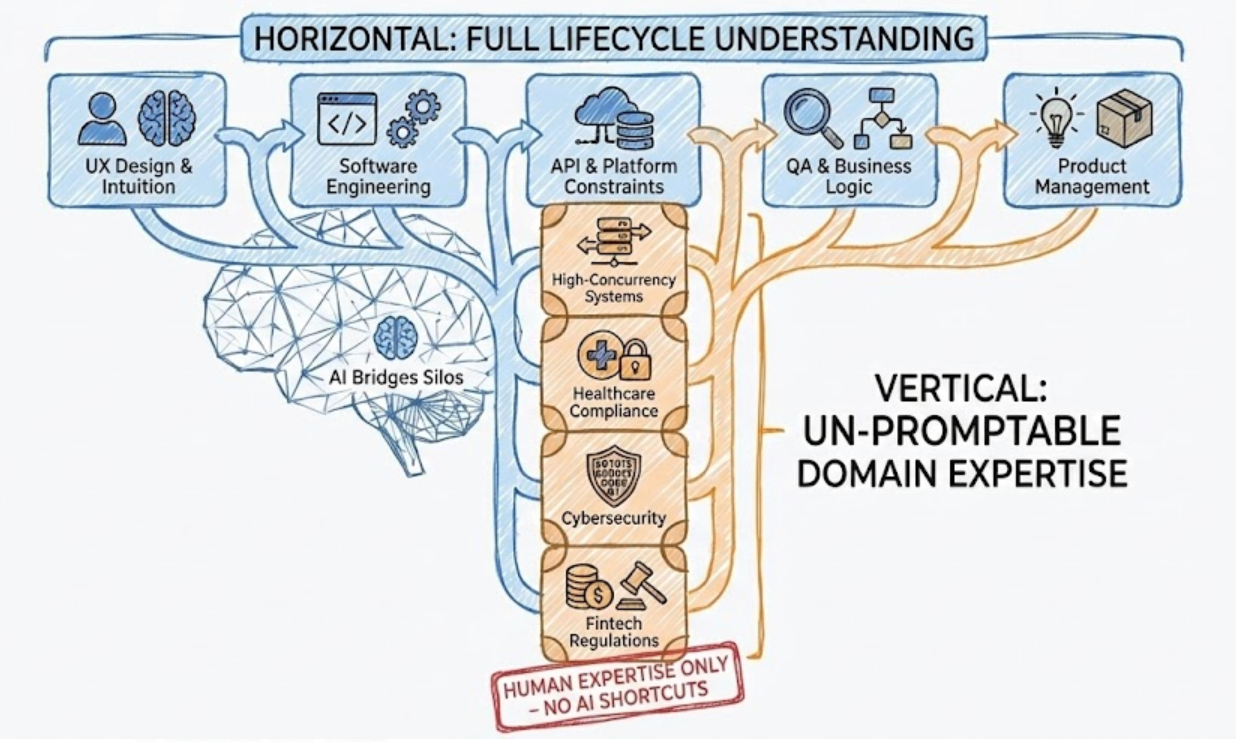
Horizontally, everyone needs a feel for the full software lifecycle. Engineers need UX intuition, PMs need to grasp platform constraints, QA needs to see the business logic. AI makes it easier to speak other disciplines. Used well, it dissolves silos instead of reinforcing them.
Vertically, you need a domain that can't be prompted. High-concurrency systems, healthcare compliance, cybersecurity, fintech, aviation software: places where a hallucination hurts someone. Human expertise isn't a luxury here. It's the only insurance.
If your daily work can be fully described in a text file, an AI will eventually do it. A durable career is built on presence, judgment, accountability, being the person who stays when things break.
We're shifting from a volume game to a value game. The world doesn't need India as its back office anymore. It needs architects, owners, people willing to carry the weight.
The fastest way to fall behind is to measure your worth in lines of code or tickets closed. Measure it by the turbulence you can handle, and by the outcomes you're trusted to guarantee.